FINDLEY STATE PARK
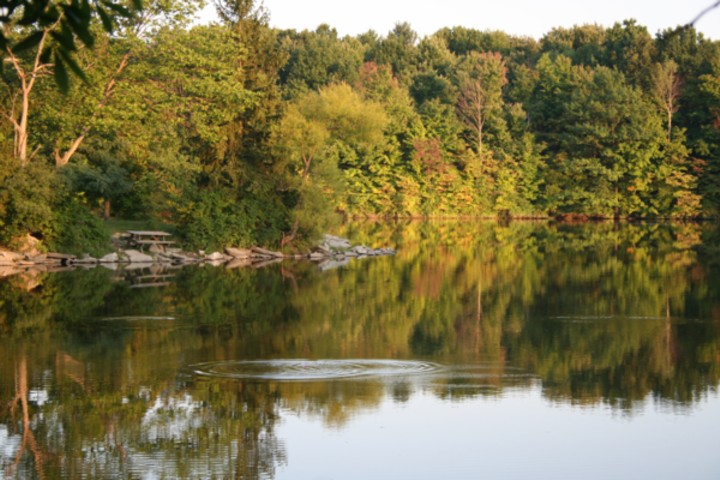
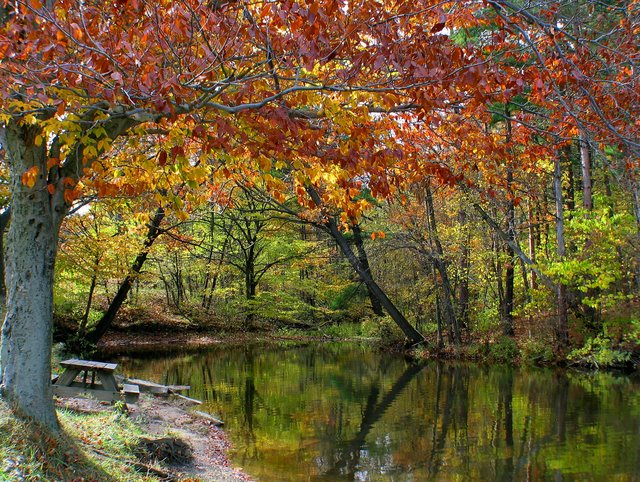
Once a state forest, Findley State Park is heavily
wooded with stately pines and various hardwoods.
The scenic hiking trails allow nature lovers to view
spectacular wildflowers and observe wildlife. The
fields, forests and quiet waters offer a peaceful
refuge for visitors.
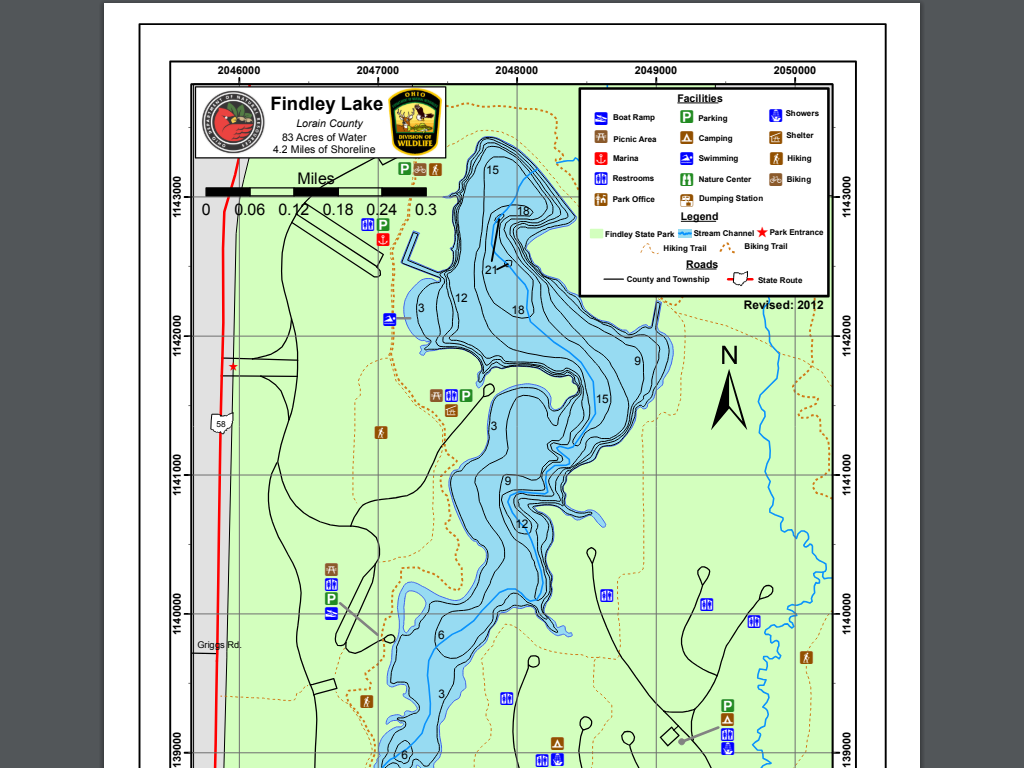
Findley Park Map (pdf)The bedrock materials underlying Findley State
Park, principally Bedford Shale and Berea
Sandstone, were formed over 300 million years ago.
In most places in Ohio, the Berea Sandstone is only
10 to 40 feet thick. In South Amherst, north of the
park, this sandstone reaches its maximum thickness
of more than 200 feet. The sandstone quarries at
South Amherst are the largest and deepest in the
world.
This part of the state is known as Ohio's dairyland.
Crops and cows are a common sight. In the midst of
this rich agricultural area is the forest oasis found
within Findley State Park. This forest is a regrowth
secondary forest on abandoned farmland. It contains
red maple, white ash, wild black cherry, oaks, white
and red pine and beech. The forest floor supports a
variety of woodland wildflowers including spring
beauties, Dutchman's breeches, hepatica, bloodroot,
marsh marigold, trillium and woodland asters.
White-tailed deer, red fox, beaver and raccoon are just a few of the animals that make this park their home. A variety
of reptiles and amphibians can be found along the lakeshore. One area of the park is set aside as a sanctuary for the
Duke's skipper butterfly, an extremely rare insect.
Long before the first settlers arrived in this area, the Erie Indians inhabited the area now known as Lorain County.
Although the Eries were fierce warriors, they were eventually subdued by a confederation formed between other
Iroquois tribes in the early 1600s using firearms obtained from the Dutch.
In 1795, the Treaty of Greenville set aside the lands north of the treaty line as a reserve for Indians. Much of the
land restricted by the treaty had previously been granted to Connecticut. This claim, known as the Connecticut
Western Reserve, ran along Lake Erie from the Pennsylvania border to present-day Erie County and included more
than 3.5 million acres. The Connecticut Land Company, after purchasing some of the land, disputed the Indian
claims and petitioned the government for the right to establish settlements on Indian lands. In 1800, Connecticut
and the Congress agreed to attach the lands in dispute to the Ohio Territory as a county.
The threat of Indians still existed in the area, so settlement was slow. In 1807, a major settlement was established at
the mouth of the Black River which later became the city of Lorain. That same year, the Connecticut Land Company
sold 4,000 acres of land of what was to become Wellington Township to four men from Berkshire County,
Massachusetts. In the winter of 1818 the four men were joined by William T. Welling of Montgomery County, New
York. Following an Indian trail, they cut their way through to the area that became known as Wellington.
Wellington today has a rich heritage. Almost seventy-five percent of the downtown district is included on the
National Register of Historic Places, reflecting the New England influence in the architecture. Many industries
flourished during the mid-1800s, most notably brickyards, wagon and carriage shops. Later, it shared the reputation
of being one of the greatest cheese producing locations in the Union. Lorain County generated annually the
equivalent of one pound of cheese for each man, woman and child in the state. Wellington was also the home of
Archibald M. Willard, painter of the classic "Spirit of 76." A copy of the work and many Willard originals hang in the
town library.
Located two miles south of Wellington is a tract of agricultural land purchased in 1936 and 1937 by Guy B. Findley,
Lorain County Common Pleas Judge. Judge Findley donated the land to the state of Ohio to be maintained as a
perpetual state forest, utilized for timber production and forest product experiments.
Findley Forest was planted by the Division of Forestry with extensive assistance from the Civilian Conservation Corps
with nearly half a million trees including many varieties of pine and hardwoods. In 1950, the forest was transferred to
the Division of Parks and Recreation to be maintained as a state park. An earthen dam, started in 1954 and
completed in 1956, created the lake.
- T Walker
Ohio does not have an annual pass and does not charge entrance fees to state parks.


 My family and I have been going to Findley State Park for almost 30 years now and have not missed a summer taking at least two trips there a year. I love this place!


 Share Your Findley State Park Photos (click here)